
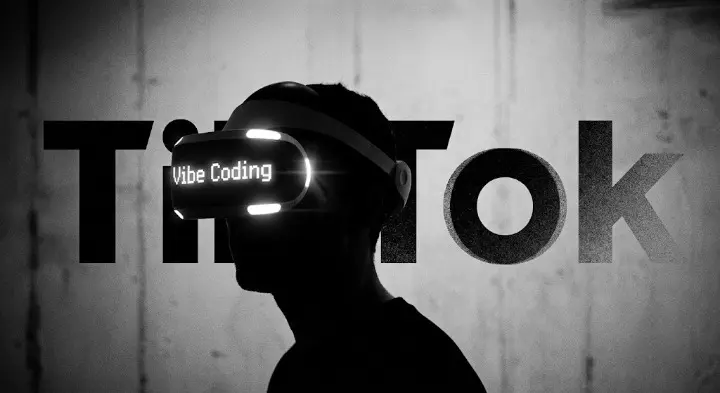
Open any tech platform right now and you will see someone building a Web application in five minutes using nothing but natural language prompts. They describe a vibe, click accept on a flurry of generated files, and deploy a working app before their coffee gets cold.
The industry calls it vibecoding. It is fast, addictive, and entirely focused on instant gratification. Which makes you wonder if it is becoming the TikTok of software engineering.
What Vibecoding Actually Is
Coined as a term to describe intent driven development where humans stop writing syntax and start directing AI models, vibecoding changes how software gets made. Instead of sitting down to map out architecture, manage state, and debug line by line, you type what you want into tools like Bolt, Lovable, or Cursor and let the model handle the heavy lifting.
The appeal is obvious. It lowers the barrier to entry so drastically that anyone with an idea can ship a product. You do not need a computer science degree or years of syntax memorization to see your concept live on the web.
Speed is the main selling point. Prototypes that used to take weeks now take an afternoon. Ideas move from thought to production instantly.
Why the TikTok Comparison Fits
TikTok changed content creation by removing friction. Anyone can record a video, apply a filter, and publish it to millions without needing professional equipment or editing skills. The focus shifted entirely to consumption speed and superficial engagement.
Vibecoding does the exact same thing to code.
When you generate an entire application via prompts without looking under the hood, you are consuming software creation as a fast paced media format rather than an engineering discipline. You get the quick hit of seeing a green deploy screen, but you bypass the friction that actually builds technical depth.
Just like endless scrolling trains short attention spans, heavy vibecoding can train developers to accept black box outputs without understanding how or why things work. If the app breaks, you do not fix the logic. You just prompt the AI to try again and hope for a better roll of the dice.
The Maintenance Nightmare
Here is where the fast food analogy breaks down into real world consequences. Eating junk food regularly catches up to your health, and accepting unverified AI code catches up to your codebase.
When an app built entirely through rapid prompting hits production edge cases, security vulnerabilities, or scaling limits, the illusion falls apart. If you do not know how the state management works or why a specific database query was structured that way, debugging turns into a guessing game. You become entirely dependent on the tool to fix the code the tool itself generated.
Technical debt accumulates exponentially when no one on the team actually understands the underlying architecture. Speed in the beginning phase turns into a complete standstill when maintenance time arrives.
Where the Real Skill Lies Now
This does not mean vibecoding is useless. Ignoring AI tools is a fast track to falling behind. Knowing how to direct models, structure context, and evaluate system outputs are genuine skills for modern developers.
The differentiator is no longer who can type syntax the fastest. It is who can review, audit, and architect systems effectively when the AI gets things wrong. Prompting an app into existence is easy. Making it robust, secure, and maintainable is where engineering actually begins.
We have to treat AI generation as a force multiplier, not a replacement for fundamental comprehension. If we treat coding like a slot machine where we keep pulling the prompt lever until something works, we stop being engineers and start being professional gamblers.